I was asked to “read” this photo for an assignment in my Introduction to Writing & Digital Studies course.
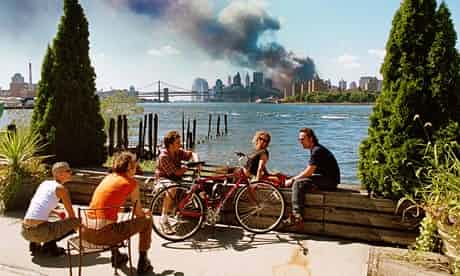
My first reaction is the photo could be fake. It’s online after all and fake or heavily edited photos have become quite common. It does look weird but that could be from the low resolution or the fact it has some unusual factors. I’ll approach it as it’s legitimate though. I begin to read this image by noticing the black smoke billowing from the city. That caught my eye because it’s out of place in context with the overall setting. It does not appear to be smog or smoke from a regular fire. I then work my way to the people and they seem quite nonchalant, but there could be any number of reasons for that. I then look over their clothes and I’d guess it’s the early 2000s based on the fashion. I go back to the setting and note it’s urban and could be New York City. I’ve never been so I’m judging it based only on all the photos and videos I’ve seen of it over the years. If I had to make a guess on this photo I would say it’s depicting a group of friends observing the aftermath of the 9/11 terrorist attack. The way the smoke appears, the fashion, and the location makes it feel very likely.
I personally don’t think there isn’t enough information to know the opinion posed in this image. If I’m correct with my guess it could be friends watching things unfold after a horrific event. I think they’re friends based on their body language and expressions. At the very least they’re friendly with each other. If I had to guess the photographer’s intention it was to capture a slice of life moment of a group of people observing a historic event and showing that life goes on. It’s based off of very little information though. The smoke is the key for me because it reminds me of the photos and videos I saw of 9/11. It’s very distinctive looking.
It turns out I was correct. This photo was taken by Thomas Hoepker and it depicts a group of people in Brooklyn watching 9/11 unfold.
In Plato’s The Republic he discusses imitation. He explains distinguishing several levels of imitation through the example of a couch: that there’s the form of the couch, the particular couch, and a painting of a couch. He states, “The products of imitation are far removed from the truth. Poets, like painters are imitators who produce imitations without knowledge of the truth.” That guy really had it out for poets! His opinion could also be applied to more modern forms of “imitation” like photography. While a photo captures a moment as it appeared through the lens at the time it was taken it can’t reveal everything about that moment.
However, I think there is much truth to be found in something like a photo. I counter that this 9/11 photo and what can be gleamed from it completely shatters Plato’s notion that imitation is far removed from the truth. If there was no truth to be found I wouldn’t have been able to determine the exact historical event this photo was showing with no other information or prior knowledge of said photo. This photo does an excellent job of showcasing that moment in time. We do need to be careful about not making assumptions though. Some people found this photo controversial because they were assuming things they couldn’t possibly know. One photo can’t possibly reveal the full truth of the event it’s depicting. It can only reveal some of it. That’s why I was hesitant to give my view on the opinion posed in this photo. There’s just no way to know for sure. Photos also don’t capture thoughts or the internal mood of its subjects or the full context of what’s happened before, during, and after it was taken. If you keep these limitations in mind it makes it easier to determine what truth actually is being revealed.
 Jonathan's Blog