Writing is evolution.
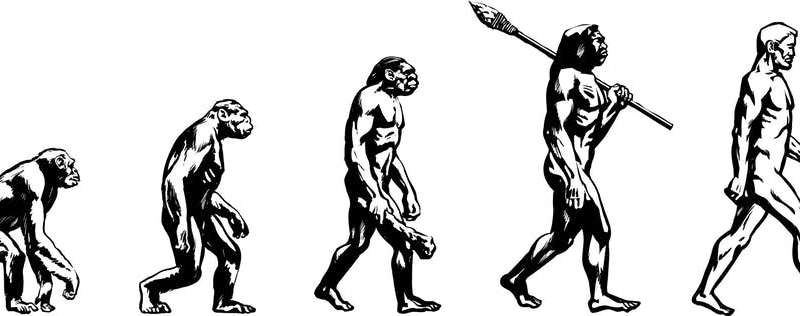
I use this image based on the classic, linear way of looking at human evolution because of what it invokes in popular culture. It’s over simplistic and the braided steam theory is a more accurate way of looking it but that requires going off a tangent that isn’t in the scope of this blog entry.
Metaphors We Live By was a groundbreaking book by George Lakoff and Mark Johnson. It covers the idea that conceptual metaphors are actually systems that govern how we act and perceive the world. Language is after all symbolic in nature and represents something else. It’s not a surprise since language itself is not literal that it’s framed by metaphor. Even something simple like the word “water” is not literally water. It just represents the concept of water.
In their book they give the example of how the concept of argument is often framed by the conceptual argument that argument is war. In English at least we use expressions like “his claim is indefensible” or “she defended her position on the matter”. We attack and defend with our words, we gain and lose ground, and we win and lose. Lakoff and Johnson argued that many of the things we do related to arguments are physically structured by the concept of war.
I was tasked with using a metaphor to describe writing. I think comparing it to evolution was a natural fit. Its structure and mechanics work the same way.
Everything about writing is an evolution. When I talk about evolution I’m specifically referring to the Darwinian natural selection type. The writing process has many similarities to it. The core of both is adaptation. Keeping what works and discarding what doesn’t. For a species to survive and flourish they must continually change their form to be better suited to the various pressures it faces from other species and its own environment. Writing has many similarities to this on both a macro and micro scale. It applies to both the delivery and the content itself.
The delivery would be the writing method employed. The earliest forms of what would eventually become writing don’t seem much like writing at all. They were things like cave drawings that represented what those early humans encountered like animals. These pictographs eventually led to logograms and in some cases continued to change into the alphabets and syllabaries that are so wide spread today. This was an evolution not unlike our progenitors. Our early hominid ancestors that were more intelligent and able to better take advantage of their environment were more likely to have offspring who were more likely to have their own offspring and so on and grew in both intelligence and became more adept at utilizing the resources in their environments. Writing systems typically become more efficient over time. That way they are better able to operate in the environment they’re used in.
On a more personal level writing is also an evolution for the person doing the writing. A writer has to adapt his words for his audience. A scientist writing an article for a peer reviewed journal would need to take a much different approach when writing for his peers than he would compared to writing an article for the layperson that’s reading about science in a magazine. If the writing approach was reversed for the widely different audiences than it wouldn’t succeed in either respective environment.
A writer’s own style ideally would improve over time as he learns new techniques and approaches. As he becomes more efficient and better able to express his voice with his written words. He learns new words and ideas over time that become incorporated into his work. He may stop using certain ideas that no longer suit his writing style, philosophies, or the environment he’s writing for.
Even how we write and express ourselves online has been an evolution. One of the most difficult things to express in text is emotional tone. When we talk face to face to another person the same words can be expressed very different depending on the tone of voice. Was there anger, sarcasm, or something else expressed in this tone? Those things are lost in text. I remember in the early days of the web that <G> was quite common. It represented a grin or grinning. To let people know you were smiling and possibly joking about something. That eventually gave way to things like “lol” short for laughing out loud and emoticons like =) and ^_^ and similar. The emoticons themselves gave way to emojis. People who’ve used <G> have had to evolve because the majority of internet users now would have no idea what it even means at this point. It’s no longer adapted to survive in the current environment of the internet and has gone extinct. The last time I remember seeing it used was in message forums in the early 2000s.
Writing is evolution because it has to continually adapt to suit its environment and pressures of the moment. Writing methods, styles, content, and delivery that don’t adapt to the changes go extinct.
 Jonathan's Blog