Featured

Writing Log #1

The Purpose of Higher Education

Today I learned about Paulo Freire. He was a Brazilian educator and considered one of the founders of critical pedagogy. “Freire believed that all education in the broadest sense was part of a project of freedom, and eminently political because it offered students the conditions for self-reflection, a self-managed life, and particular notions of critical agency (Giroux.)” As Stanley Aronowitz stated, “for Freire literacy was not a means to prepare students for the world of subordinated labor or ‘careers’, but a preparation for a self-managed life.”

I agree with the heart of Freire’s philosophy. Higher education should be about giving students the tools they need to lead self-fulfilled, fully realized lives, and prepare students to think critically in all areas. It should be about more than just being another cog in the machine or making a certain amount of money. While jobs and money are important things in our society, they are not the be all and end all, even though I do think higher education should help prepare students for the work force. That doesn’t necessarily mean teaching them the skills they need for a specific job, but teaching them broader skills that can be applied to many different facets of their lives. There are merits to learning for the sake of learning, self-improvement, and just being a better person to elevate our society as a whole.

As a society and culture everyone suffers when the focus on higher education is only to get a job and make money. It leads students to major in areas of study for the wrong reasons. I’ve known people who have picked majors only because they thought they were easy as well as people whose choice of major was only because they viewed it as the most marketable. I think that sort of mentality is far removed from what the true purpose of higher education should be. People should be pursuing higher education as a means to become the best versions of themselves. In doing so not only do they achieve something that’s monetary value can’t be quantified but it also makes them better prepared for the various challenges life brings yet still gives them the tools to be valuable assets in the work force. I don’t think it’s an either or situation.

There’s a Forbes article called “What’s The Purpose Of College?” by Brandon Busteed. In it he proposes that we consider the purpose of college instead of asking if it’s worth it. He breaks down the false dichotomy between the two perceived purposes of college. One of which is preparing a person for work while the other is preparing a person for life, “to be an engaged and enlightened citizen capable of thinking critically and communicating clearly, ultimately able to thrive in their well-being (Busteed.)” He pushes the notion that it’s not one or the other but both. I think that’s the most realistic approach. He also points out the need for people to have a purpose, which they often find through their work, and in doing so improves their overall well-being.

Education, at its core is also about freedom. The freedom to make informed decisions and essentially be in control of one’s own destiny. The better educated the public is the better they can make choices that not only improve their own lives but the lives of everyone in society. It’s unfortunate that many supposed institutions of education fail to realize that or deliberately subvert it. “Pedagogy is by definition directive, but that does not mean it is merely a form of indoctrination (Giroux.)” I’ve experienced firsthand, especially in K-12, that many educators don’t encourage critical thinking and only want blind obedience. I often got in trouble for questioning why we were learning something or for even just wondering the relevance. It was like we were robots being programmed to perform specific tasks and anything outside of that scope wouldn’t be permitted. Ultimately education should be about cultivating self-awareness and the freedom to make well-informed and conscientious decisions.

                                        Works Cited                                                       

Busteed, Brandon. “What’s The Purpose Of College?” Forbes, 10 Apr. 2019,
          http://www.forbes.com/sites/brandonbusteed/2019/04/10/whats-the-purpose-of-
          college/#57b310bf354e.

Giroux, Henry A. “Rethinking Education as the Practice of Freedom: Paulo Freire          
           and the Promise of Critical Pedagogy.” Policy Futures in Education, vol. 8, no. 6,
          2010, pp. 715–721., doi:10.2304/pfie.2010.8.6.715.
Writing Log #8: Writer/Writing as Metaphor

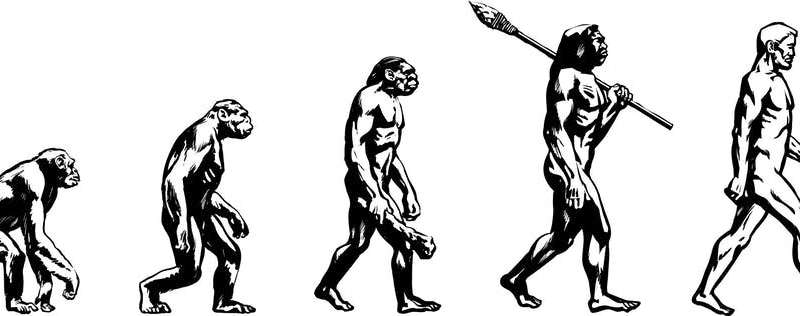
Writing is evolution.

I use this image based on the classic, linear way of looking at human evolution because of what it invokes in popular culture. It’s over simplistic and the braided steam theory is a more accurate way of looking it but that requires going off a tangent that isn’t in the scope of this blog entry.

Metaphors We Live By was a groundbreaking book by George Lakoff and Mark Johnson. It covers the idea that conceptual metaphors are actually systems that govern how we act and perceive the world. Language is after all symbolic in nature and represents something else. It’s not a surprise since language itself is not literal that it’s framed by metaphor. Even something simple like the word “water” is not literally water. It just represents the concept of water.

In their book they give the example of how the concept of argument is often framed by the conceptual argument that argument is war. In English at least we use expressions like “his claim is indefensible” or “she defended her position on the matter”. We attack and defend with our words, we gain and lose ground, and we win and lose. Lakoff and Johnson argued that many of the things we do related to arguments are physically structured by the concept of war.

I was tasked with using a metaphor to describe writing. I think comparing it to evolution was a natural fit. Its structure and mechanics work the same way.

Everything about writing is an evolution. When I talk about evolution I’m specifically referring to the Darwinian natural selection type. The writing process has many similarities to it. The core of both is adaptation. Keeping what works and discarding what doesn’t. For a species to survive and flourish they must continually change their form to be better suited to the various pressures it faces from other species and its own environment. Writing has many similarities to this on both a macro and micro scale. It applies to both the delivery and the content itself.

The delivery would be the writing method employed. The earliest forms of what would eventually become writing don’t seem much like writing at all. They were things like cave drawings that represented what those early humans encountered like animals. These pictographs eventually led to logograms and in some cases continued to change into the alphabets and syllabaries that are so wide spread today. This was an evolution not unlike our progenitors. Our early hominid ancestors that were more intelligent and able to better take advantage of their environment were more likely to have offspring who were more likely to have their own offspring and so on and grew in both intelligence and became more adept at utilizing the resources in their environments. Writing systems typically become more efficient over time. That way they are better able to operate in the environment they’re used in.

On a more personal level writing is also an evolution for the person doing the writing. A writer has to adapt his words for his audience. A scientist writing an article for a peer reviewed journal would need to take a much different approach when writing for his peers than he would compared to writing an article for the layperson that’s reading about science in a magazine. If the writing approach was reversed for the widely different audiences than it wouldn’t succeed in either respective environment.

A writer’s own style ideally would improve over time as he learns new techniques and approaches. As he becomes more efficient and better able to express his voice with his written words. He learns new words and ideas over time that become incorporated into his work. He may stop using certain ideas that no longer suit his writing style, philosophies, or the environment he’s writing for.

Even how we write and express ourselves online has been an evolution. One of the most difficult things to express in text is emotional tone. When we talk face to face to another person the same words can be expressed very different depending on the tone of voice. Was there anger, sarcasm, or something else expressed in this tone? Those things are lost in text. I remember in the early days of the web that <G> was quite common. It represented a grin or grinning. To let people know you were smiling and possibly joking about something. That eventually gave way to things like “lol” short for laughing out loud and emoticons like =) and  ^_^ and similar. The emoticons themselves gave way to emojis. People who’ve used <G> have had to evolve because the majority of internet users now would have no idea what it even means at this point. It’s no longer adapted to survive in the current environment of the internet and has gone extinct. The last time I remember seeing it used was in message forums in the early 2000s.

Writing is evolution because it has to continually adapt to suit its environment and pressures of the moment. Writing methods, styles, content, and delivery that don’t adapt to the changes go extinct.

Writing Log #7: Finding CNF Inspiration

Creative nonfiction was a genre that I was only recently introduced to. It’s both familiar in some ways and yet quite alien at the same time to the type of literature I usually read. This is a genre that’s definitely expanding my horizons on just what forms both writing and artistic expression can take.

One thing that I found a little more difficult for me to relate to is that many of the authors who populate this particular genre have a very flowery, overly descriptive style that does not mesh well with my preferences as either a writer or reader. Some of the works also delve too deep into emotions which I also don’t find appealing. However, I didn’t think that was a limitation of the genre, in fact this genre seems quite flexible. I was even able to find a writer whose style I found more comfortable and compatible with my own.

That writer is Chen Li. I actually found two different essays of his but I’ll focus on Mushan’s Blacksmith Shop. The form that contributes the most to the piece is that while he states at the beginning that the blacksmith is getting old he doesn’t leave it at just that. He illustrates it with his language. Everything he describes explains why the blacksmith is getting old. He’s napping during the day, he has gray hair, and dreams of times long past. He frames it all by starting the very beginning and the last paragraph of the piece with “The blacksmith of Mushan’s Blacksmith Shop is getting old.” The full circle drives that fact home in a neat package.

The piece is made aesthetic by using colorful language to paint the picture of the scene in the reader’s head rather than using drab, matter of fact language. Like, “In the balmy sunshine, his gray hair sparkles with the same silver glints as those on his reading glasses.” Another literary device used is metaphor, “Nowadays, ditchwater and rainwater all converge in front of the shop. Those pedicabs—no, they’re iron bullock carts now—almost turn into motorboats.” The comparison emphasizes the amount of water collecting in front of the shop and how there’s so much water that carts going through it must churn through all the water just like a motorboat.

The ethics the writer seems to be using is relaying what he personally experienced and observed. When he goes beyond the known he attributes it to the blacksmith possibly dreaming. Only the blacksmith himself would know if that’s the case and since many people forget their dreams even he may not know for sure. I think that’s using his artistic license as a writer responsibly. He’s not attributing words to the blacksmith that the blacksmith never spoke or making events up, only speculating what he may have dreamed about.

Chen maintains an authentic tone to his piece. That’s one of my main concerns when writing my next CNF piece. I want to be descriptive and entertaining but also authentic. It also inspires me to use colorful language in such a way that it helps to give my readers a taste of what my experiences were actually like. They’re not just reading or hearing about my experiences but reliving at least a little bit of it themselves as I use my words to take them on a literary adventure.

Writing Log #6: Six Word Memoir

Fresh baked cookies, memories of grandma.

Bruises, sweat, tears; taekwondo rank blackbelt.

Friendly people, great food: Vietnam vacation.

Smiles, laughs, butterflies: successful first date.

Proud parents: College acceptance letter arrived.

First love: anger, tears; difficult goodbye.

Rescued kitten, given love, starts purring.

Grateful for Japanese lessons, arigato mom.

Blisters on Monday; weekend game champion.

Go-kart brakes don’t work, hurt leg.

What I liked about this form of creative non-fiction was that it’s clearly defined. It needs to be 6 words exactly, not 5 or 7. It really made me have to think to fit those narrow parameters. I had to be innovative to share a compelling story but at the same time I had to make sure it also made sense. It wasn’t like anything I had written before and I think it’s good to try new writing styles and get outside of my comfort zone. It reminded me a bit of haiku.

However, the limited writing style was also something I didn’t like. It’s good to have guidelines but I found it a little too limiting. I think it’s quite difficult to make the stories entertaining when they’re this length. Hemingway’s example is clever and well done but I don’t find it particularly interesting even though it’s quite deep and nuanced considering its limitations.

Writing Log #5: Writing in Digital Spaces v. Analog

Digital spaces offer unique advantages and challenges to more traditional writing formats. My first blog entry is a good representation of my analog composition process. Even though it’s in a digital space its structure is no different than a typical paper I’d write for class, complete with conventional citations. It didn’t use images, hypertext, or other affordances a digital space provides.

My second blog was when I started to make use of some of the digital affordances. As you can see in the screenshot below, I started the blog with an illustration of quill and ink to conjure in the reader thoughts and images related to the writing process before they had even read a word of text. I also made the interviews of the authors I referenced more accessible to the reader by turning the authors’ own names into hyperlinks within my post instead of providing conventional citations.

For my third blog the affordances I took of advantage of were embedding the photo that I’m commenting on in the post as well as providing hyperlinks for both the backstory of the photo itself but even Plato’s The Republic, which my instructor had referenced, in the assignment details.

The affordance in my fourth blog sets the mood for a podcast with the illustration and truly takes advantage of the affordance of a link to the podcast so the blog is no longer strictly visual but an aural experience as well. While it’s not that unusual to provide images in Word documents or with paper based assignments they would not be accompanied with audio within the text itself due to format and logistical limitations.

In this fifth blog entry I link to all my past blogs and provide photos to help document my journey up until now.

When composing a primarily text based post, like a blog, I want to take use the tools at my disposal to make the experience more enjoyable and easier for my readers. At the same time I think when I compose digitally I should avoid the traps some people fall into by providing all sorts of unnecessary bells and whistles. Many websites fall into that trap where they’re so complicated and have so many extra things that they don’t provide a good experience or even deliver their primary focus adequately. It reminds me of the Myspace pages of yesteryear. Some people went so overboard with animated gifs, blaring music that automatically played, and custom everything that it made an overwhelming and irritating experience for visitors. It’s no wonder that other more streamlined and uniform social media platforms eventually replaced it. It provided so many functions it lost sight of its true purpose.

The biggest shift in my composition process is the focus on the reader’s experience. When doing a normal assignment the only thing that matters is if the writing is good and that it meets the requirements the instructor outlines. When you make a blog post you have to worry a lot more about things like presentation, accessibility, navigation, and even entertainment value because of the presumed larger audience that goes beyond just the instructor or your classmates. There are multiple constraints in an environment such as this though. One is that brevity is important. People typically have shorter attention spans in digital environments. Second, WordPress has limitations related to the type of files you can embed in your posts because of security, bandwidth, technological, and even financial reasons. A third big constraint, as previously mentioned, is remembering to use the affordances available to enhance my posts and not distract from them. I think providing a good experience for the reader/user is paramount.

Writing Log #4: Writing for Aural Delivery

View on Vocaroo >>

Listen to my first podcast above or read the script for it below!

Hi! I’m Jonathan!

This will be the first time I’m making my own podcast. I considered all the different topics I could cover and I decided I’d enjoy some of the questions that linguistic study has raised in my mind. For those that don’t know linguistics is the scientific study of language. I’ve been fortunate enough to take two linguistics courses so far. The History of the English Language at UC Berkeley and Language Theory at CU Denver. I’m definitely still a novice on this subject but I’m always trying to learn more about it and deepen my understanding of the field.

My introduction to linguistics was the Berkeley course and I found it fascinating! I loved learning about the history of the English language and all the changes the language has gone through from Old to Modern English and everything in between. I especially enjoyed translating passages from Old and Middle English into Modern English. Yes, I’m very weird! Just to clarify for people not that familiar with older forms of English, Old English is not Shakespearean English, despite the impression you may have gotten from movies! That’s actually Early Modern English. Old English is the oldest form of English that was first written with runes and the greatest literary work from that period would be the epic poem, Beowulf. Middle English comes next and the best known work from that period is Chaucer’s Canterbury Tales.

That class also answered so many questions I had going back to childhood about English language spelling. When I questioned why something was spelled the way it was I was told “that’s just the way it is” or “do as I say and learn it”. I clearly had a knack for annoying my teachers in elementary school. My teachers should have appreciated a student that took an actual interest in learning but I suppose that was too much to ask. I would have much preferred an actual explanation! I should preface this by saying that spoken English kept changing after spelling was standardized. A perfect example is the word “knight”. That’s k-n-i-g-h-t. The “k” is silent in Modern English but was not in Old English. It was pronounced something like “ka” “night”. Why couldn’t a teacher have just explained that to me as a kid! I would have been much more agreeable if I had known the actual history. I hated being forced to do something just because the teacher said to!

That leads me to one of the enduring principles of linguistics and something that I still ponder. It’s the principle that languages tend to simplify over time. Old English was much more complex than Modern English. Going back to my example of the word  “knight”, that’s an example of simplification. It’s common for sounds in words to be dropped over time if they aren’t really needed to be understood. It wasn’t really needed to say “ka night” to know you were talking about a knight so the spoken word was shortened over time. It’s very similar to slang words. Like “”homeboy” eventually becoming just “homie” or even “homes”.

It’s not surprising that the speakers of a language would want to make it more efficient overtime. But that leads me to a question. Why did languages like Old English or Classical Latin become so complex in the first place if languages have a tendency to simplify over time? Since the earliest forms of human speech wouldn’t have been more than just grunting, clearly languages initially had to get much more complex before they started to simplify. I haven’t found an answer to that question yet.

On a related note I’ll leave my listeners, all three of them, with one final question to ponder. I’ve noticed that there are instances in Modern English of unnecessary redundancy being added. Examples of that include “extend out”, “retract in”, and “also too”. That’s adding extra unnecessary words that don’t add any additional meaning. That’s not efficient or simplified. So, why are these redundant expressions becoming so common?

I’m Jonathan and this is the end of my first podcast!

My personal reflection:

The way my composition process was changed with an oral delivery is that I focused on making it more conversational, made sure I injected some humor, and had a more emphatic delivery. It was a bit of oral storytelling as I used this medium to take my listeners on a journey to my past, educate them a bit on the subject of linguistics, and guide them through my own musings.

Writing Log #3: Visual Literacy

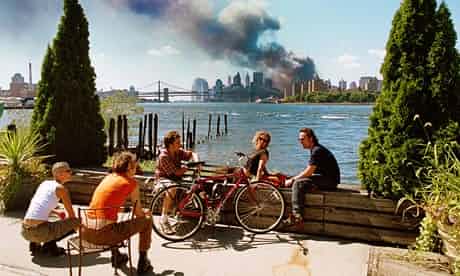
I was asked to “read” this photo for an assignment in my Introduction to Writing & Digital Studies course.

My first reaction is the photo could be fake. It’s online after all and fake or heavily edited photos have become quite common. It does look weird but that could be from the low resolution or the fact it has some unusual factors. I’ll approach it as it’s legitimate though. I begin to read this image by noticing the black smoke billowing from the city. That caught my eye because it’s out of place in context with the overall setting. It does not appear to be smog or smoke from a regular fire. I then work my way to the people and they seem quite nonchalant, but there could be any number of reasons for that. I then look over their clothes and I’d guess it’s the early 2000s based on the fashion. I go back to the setting and note it’s urban and could be New York City. I’ve never been so I’m judging it based only on all the photos and videos I’ve seen of it over the years. If I had to make a guess on this photo I would say it’s depicting a group of friends observing the aftermath of the 9/11 terrorist attack. The way the smoke appears, the fashion, and the location makes it feel very likely.

I personally don’t think there isn’t enough information to know the opinion posed in this image. If I’m correct with my guess it could be friends watching things unfold after a horrific event. I think they’re friends based on their body language and expressions. At the very least they’re friendly with each other. If I had to guess the photographer’s intention it was to capture a slice of life moment of a group of people observing a historic event and showing that life goes on. It’s based off of very little information though. The smoke is the key for me because it reminds me of the photos and videos I saw of 9/11. It’s very distinctive looking.

It turns out I was correct. This photo was taken by Thomas Hoepker and it depicts a group of people in Brooklyn watching 9/11 unfold.

In Plato’s The Republic he discusses imitation. He explains distinguishing several levels of imitation through the example of a couch: that there’s the form of the couch, the particular couch, and a painting of a couch. He states, “The products of imitation are far removed from the truth. Poets, like painters are imitators who produce imitations without knowledge of the truth.” That guy really had it out for poets! His opinion could also be applied to more modern forms of “imitation” like photography. While a photo captures a moment as it appeared through the lens at the time it was taken it can’t reveal everything about that moment.

However, I think there is much truth to be found in something like a photo. I counter that this 9/11 photo and what can be gleamed from it completely shatters Plato’s notion that imitation is far removed from the truth. If there was no truth to be found I wouldn’t have been able to determine the exact historical event this photo was showing with no other information or prior knowledge of said photo. This photo does an excellent job of showcasing that moment in time. We do need to be careful about not making assumptions though. Some people found this photo controversial because they were assuming things they couldn’t possibly know. One photo can’t possibly reveal the full truth of the event it’s depicting. It can only reveal some of it. That’s why I was hesitant to give my view on the opinion posed in this photo. There’s just no way to know for sure. Photos also don’t capture thoughts or the internal mood of its subjects or the full context of what’s happened before, during, and after it was taken. If you keep these limitations in mind it makes it easier to determine what truth actually is being revealed.

Writing Log #2

Where do fiction authors get their ideas?

Where do fiction authors get their ideas? Obviously there is a huge variation from author to author but the simplest answer is they get many of their ideas from mining experiences in their own lives. Stephen King got his idea for Cujo, the novel about a killer dog, after encountering an aggressive St. Bernard that came charging towards him at a motorcycle repair shop. King was scared because he knew he wouldn’t be able to out run the dog and there was nowhere to go if the owner hadn’t stopped his dog. King wondered what if it hadn’t been a mean dog but a crazy dog. Then he thought maybe it’s rabid. Once he had written 70 or 80 pages he found out that the incubation period for rabies was too long, so that was no longer an option. As King put it, “You can never bend reality to serve the fiction. You have to bend the fiction to serve reality when you find those things out.”

The ideas for King’s stories start to flesh out more when he starts to consider the ramifications of what happens next. He got his idea for Cell when he came out of a hotel in New York and saw a woman talking on the phone. King thought to himself, “What if she got a message over the cell phone that she couldn’t resist, and she had to kill people until somebody killed her?” This book was derived from the concern of how we communicate with each other today.

While King tends to get inspiration from experiences he observes in his own day to day life other authors get inspiration from observing things from a larger scale. Brandon Sanderson got his idea for the world of Roshar, featured in his Stormlight Archive series, from thinking about the massive persistent storm on the planet Jupiter. The seed that started from thoughts about the power of that storm continued to grow for months and years and as it became mixed with other things eventually lead to the creation of Roshar. For the magic system in his universe he took inspiration from the Shinto religion of Japan that has the belief that every single object has a soul.

When I’ve written fiction stories I also usually start from my own experiences and observations and then let the ideas take a fantastical life of their own. I remember an assignment in junior high school where we had to write about what we did on our summer vacation. Normally I found assignments like that quite boring, so I decided to spice things up by adding a science fiction element to what would otherwise have been a mundane, real life story. I often wondered if we weren’t alone in the universe and who or what could be out there. That lead me to think about just what would have happened if I had been abducted by aliens during my summer vacation. How would I have reacted and what would I have done next? That idea quickly morphed into elaborate tales of government conspiracies, cold alien examination rooms, and out of this world adventures.

I ended up not only entertaining myself, but the other students, and even the teacher. Luckily she had a sense of humor and appreciation for a weird kid, so I even got a good grade after deviating significantly from the original assignment. That’s a common trend I noticed with authors of fiction. They get an idea, often from an ordinary source, but add a what if element to it, and then let their imaginations run wild trying to answer that question.

Create your own website, free on WordPress.com.Create your own website.
Start free